"Technical tools are neutral, take this knife for example"
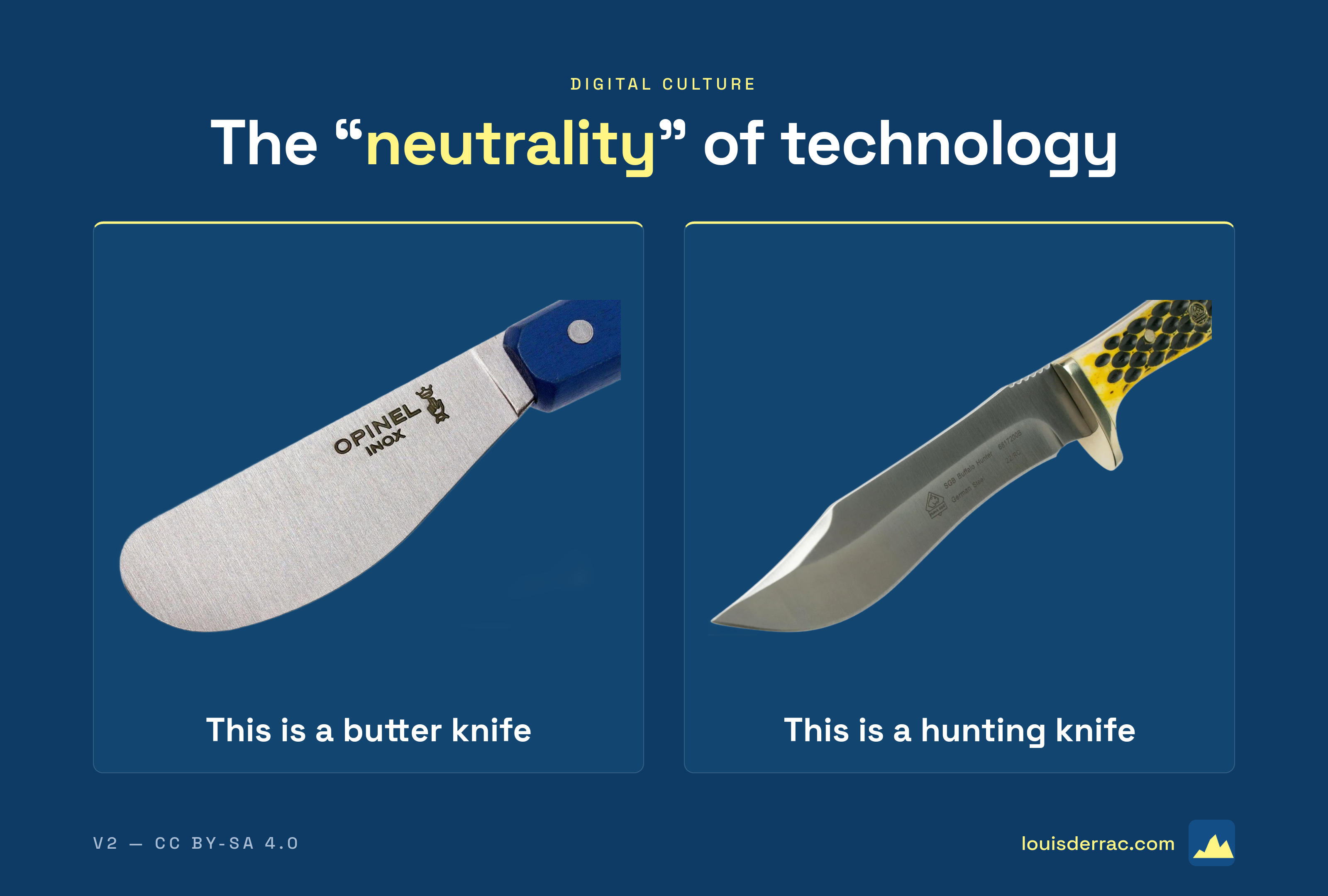
Technologies, as such, are neutral - that is, neither good nor bad: it all depends on how we use them. Can't a knife be used just as well to butter a slice of bread as to kill a person?
We hear or read this sentence almost systematically whenever the impact of technologies on our lives is discussed. The underlying assumption is that it makes no sense to criticize technologies, since they would be neutral and their effects would depend exclusively on our uses and practices. For example, Facebook or TikTok are neither good nor bad; it depends on what we do with them. The same goes for generative AI systems or video surveillance systems.
Much has been written on this subject, and it is sad that even today we still have to challenge this supposed "neutrality of technology" (which is omnipresent in debates about AI, for example). But allow me a little demonstration aimed at the general public, using the illustration below, which you are obviously free to reuse (download its editable version for Gimp).
Do you see where I'm going with this? Do you see the difference between these two knives? One was designed - with "design" in the true sense of the word - to kill, the other was not. One is pretty, colorful; the other is dark, even camouflaged. They are both knives, but conceived for two totally different practices and uses.
Knives, like any technical object (however simple or complex), are absolutely not neutral. They are designed with an intention, for a specific purpose, with systems of biases and beliefs. This design predisposes certain practices and uses (we then speak of affordance). Keep this in mind every time you read or hear that such an algorithm or such an AI is neutral...
Going Further with Damasio
To go further, I'd like to share an excerpt from Damasio's recent essay, Silicon Valley, which I find both clear and powerful:
To these techno-critical approaches, Silicon Valley often opposes this cliché, which should be shot down without warning and at point-blank range. It goes like this: technology is neutral; its impact ultimately depends only on whether we make good or bad use of it.
This is a short idea, and even a stupid one - quadruply stupid. It is never useless to restate why:
1° Because technology carries within it a latent value: efficiency. In other words: the possibility of acting strongly on our environments. Every machine predisposes the user to make efficiency the value of their action, before any choice on their part. This value has contaminated all domains to the point that a startup founder today must be high-performing in professional, economic, athletic, and even sexual spheres.
More profoundly, technology is a way of revealing reality as that which must be harnessed, as Heidegger already pointed out - that is, brought to reason, mobilized, exploited, and compelled to deliver energy that can be extracted and accumulated. This, obviously, is anything but neutral. Other relationships to reality were and remain possible: the search for harmony, listening, contemplation, symbiosis...
2° Because upstream, technological innovation depends on Research, which itself depends on research funding or venture capital invested, and therefore already on a strong preselection of discoveries, products, and services deemed a priori "useful" to develop because they are profitable. The machine thus always remains "social before being technical" (Deleuze), meaning that within a capitalist universe, to be ultimately manufactured, it presupposes a market expectation and profitability. Millions of innovations that would improve our common condition will never cross the threshold of production. There is therefore no neutrality, even in the very possibility of existing.
Let's take two examples. An RFID chip predisposes, from its very conception, that we will seek to identify shoes, comfort objects, birds, lynxes, trees, motorcycles, and even our own children to ensure the traceability of these targets: nothing can exist or move anymore without being kindly tracked. "Give me your coordinates." Generative AI: its technological developments will always be subject to the biases and imperatives (financial, governmental, even personal) of those who control them and profit from them, and not aligned with a search for the common good or the enlightened education of all.
3° Because downstream, a technology induces a multitude of effects, often difficult to anticipate: it reinvents practices and reformats behaviors, it sometimes gives birth to an entire culture (massively multiplayer games, internet dances, animatics) simply through the new interactions it offers. Using it already means transforming one's relationship to oneself and one's relations with others, creating new grips and consenting to future controls by outsourcing old capacities to the app. The digital constantly delivers unexpected options that we never imagined would enter into usage. Mobile geolocation was not originally intended, nor was the explosion of autocompleted SMS or the generalization of a social norm: being reachable at all times. Generative AI was not designed to humiliate women with elaborate pornographic deepfakes created from ordinary videos. Your emails were not meant to be read and datamined.
4° Finally, because every technology carries within it a new relationship to the world. We think we are using a refrigerator when it is our way of feeding ourselves that is revolutionized by the storage of fresh food. The machine situates our freedom, and our freedom is exercised facing it, within it. We are free in our uses of the machine, even free not to use it, sometimes. But this is a situated freedom, a free will exercised within a world transformed and re-potentialized by the machine, where it becomes impossible to behave as if it did not exist. The car literally "invented" roads, parking lots, and sidewalks; it called for oil extraction and entirely re-founded land-use planning. Social networks invented community without presence, self-exposure, the selfie, possible exclusion, harassment, and digital stoning. AI is currently inventing self-conversation and the digital twin, among hundreds of reinventions of our ways of working.
By this fourfold measure, to still believe in the neutrality of the technologies offered to us is no longer even naivety. It is a political fault.