<?xml version="1.0" encoding="utf-8"?>
<feed xmlns="http://www.w3.org/2005/Atom" xmlns:media="http://search.yahoo.com/mrss/">
    <title>An Ecogeek in the Mountains</title>
    <link href="https://blog.louisderrac.com/en/feed.xml" rel="self" />
    <link href="https://blog.louisderrac.com/en" />
    <updated>2026-09-30T10:27:04+02:00</updated>
    <author>
        <name>Louis Derrac</name>
    </author>
    <id>https://blog.louisderrac.com/en</id>

    <entry>
        <title>AI is going to take your job !</title>
        <author>
            <name>Louis Derrac</name>
        </author>
        <link href="https://blog.louisderrac.com/en/ai-is-going-to-take-your-job/"/>
        <id>https://blog.louisderrac.com/en/ai-is-going-to-take-your-job/</id>
        <media:content url="https://blog.louisderrac.com/en/media/posts/553/aijobwhen-3-lg.png" medium="image" />
            <category term="tech"/>

        <updated>2026-09-30T10:16:32+02:00</updated>
            <summary type="html">
                <![CDATA[
                        <img src="https://blog.louisderrac.com/en/media/posts/553/aijobwhen-3-lg.png" alt="A woman washing dishes with a sarcastic caption mocking the idea that AI will take her job. She replies &quot;when ?&quot;" />
                    "AI is going to take your job!" "When???" Well, it's nothing groundbreaking, but this video, which I found while wandering through Maggie Appleton's impressive digital&hellip;
                ]]>
            </summary>
        <content type="html">
            <![CDATA[
                    <p><img src="https://blog.louisderrac.com/en/media/posts/553/aijobwhen-3-lg.png" class="type:primaryImage" alt="A woman washing dishes with a sarcastic caption mocking the idea that AI will take her job. She replies &quot;when ?&quot;" /></p>
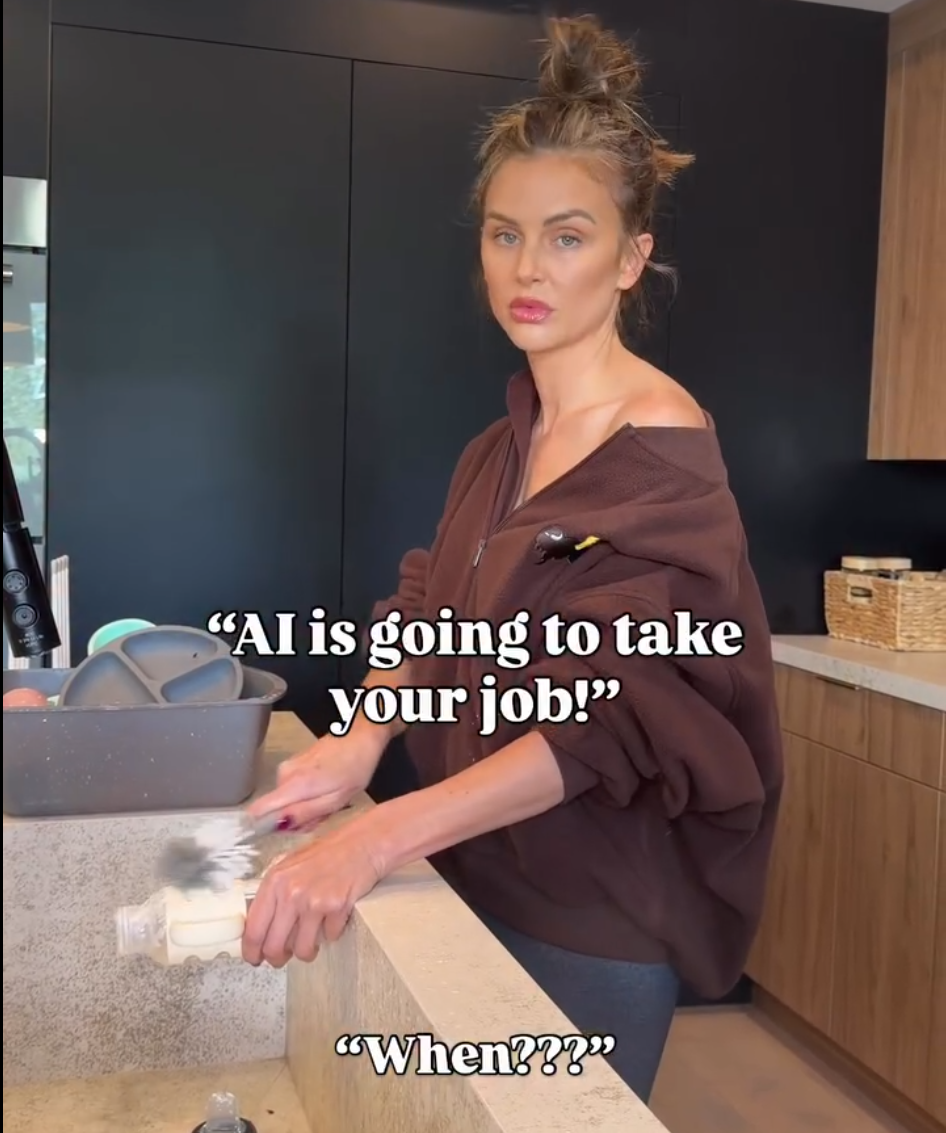
                <p dir="ltr">"AI is going to take your job!"<br>"When???"</p>
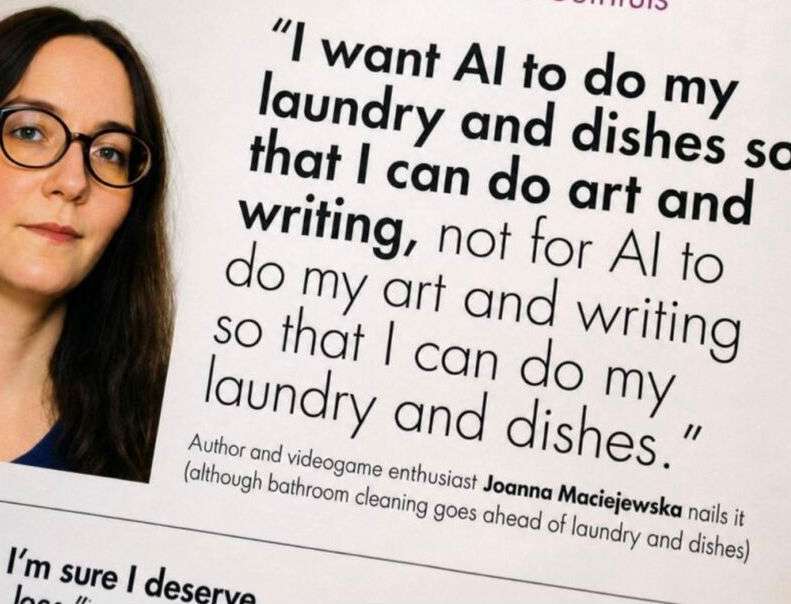
<p dir="ltr">Well, it's nothing groundbreaking, but this <a href="https://www.instagram.com/reel/DUyorsnkhJQ/"  class="extlink extlink-icon-1"  >video</a>, which I found while wandering through <a href="https://maggieappleton.com/now"  class="extlink extlink-icon-1"  >Maggie Appleton's impressive digital garden</a>, made me laugh. It's partly what I think of when people talk about being "replaced by AI" 😂 As a reminder, <a href="https://x.com/AuthorJMac/status/1773679197631701238?lang=en"  class="extlink extlink-icon-1"  >Joanna Maciejewska</a> went viral in 2024 with a fairly similar message about AI and its ability to take [only the most fulfilling part of] our work. The full quote:</p>
<blockquote dir="ltr">
<p dir="ltr">You know what the biggest problem with pushing all-things-AI is? Wrong direction. I want AI to do my laundry and dishes so that I can do art and writing, not for AI to do my art and writing so that I can do my laundry and dishes.</p>
</blockquote>
<figure class="post__image"><img loading="lazy"  src="https://blog.louisderrac.com/en/media/posts/553/1788155165771-3-lg.jpg" alt="A quote by author Joanna Maciejewska stating she wants AI to do chores so she can do art, not the reverse." width="791" height="604" sizes="(min-width: 920px) 703px, (min-width: 700px) calc(82vw - 35px), calc(100vw - 81px)" srcset="https://blog.louisderrac.com/en/media/posts/553/responsive/1788155165771-3-lg-xs.jpg 300w ,https://blog.louisderrac.com/en/media/posts/553/responsive/1788155165771-3-lg-sm.jpg 480w ,https://blog.louisderrac.com/en/media/posts/553/responsive/1788155165771-3-lg-md.jpg 768w ,https://blog.louisderrac.com/en/media/posts/553/responsive/1788155165771-3-lg-lg.jpg 1024w"></figure>
<p dir="ltr">Now, if we take a more technocritical and feminist angle and compare the arrival of a technology like AI to that of the washing machine, literally sold as a way to "free women from one of their chores", we should remember that this kind of technology tends to shift the workload rather than remove it entirely. This is the core argument of historian Ruth Schwartz Cowan in More Work for Mother (1983): household appliances did not significantly reduce the time spent on housework, because standards of cleanliness rose (clothes washed more often, for instance) and because tasks once shared or delegated, to servants or children, ended up on the housewife alone. The same pattern is visible today: inequalities in household chores <a href="https://www.inegalites.fr/inegalites-taches-domestiques-femmes-hommes"  class="extlink extlink-icon-1"  >remain very significant</a> in 2026 (link in French). Here, I'm sharing a video from Le Vortex (a French YouTube channel) that I watched on the subject.</p>
<figure class="post__video"><iframe loading="lazy" width="560" height="314" src="https://www.youtube-nocookie.com/embed/7QXrrU7wp30" allowfullscreen="allowfullscreen" data-mce-fragment="1"></iframe></figure>
<p dir="ltr">That's all for this post! It all started from reading the "Now" page on Maggie Appleton's site. I also discovered Judy Brady's text there, "<a href="https://www.sevanoland.com/uploads/1/1/8/0/118081022/_brady_i_want_a_wife.pdf"  class="extlink extlink-icon-1"  >I want a wife</a>". Happy Sunday, and long live the indieweb and serendipity!</p>
            ]]>
        </content>
    </entry>
    <entry>
        <title>Who can do without WhatsApp?</title>
        <author>
            <name>Louis Derrac</name>
        </author>
        <link href="https://blog.louisderrac.com/en/who-can-do-without-whatsapp/"/>
        <id>https://blog.louisderrac.com/en/who-can-do-without-whatsapp/</id>
        <media:content url="https://blog.louisderrac.com/en/media/posts/552/bd552b7257d5514a-3-lg.jpg" medium="image" />
            <category term="tech"/>
            <category term="social"/>

        <updated>2026-09-30T10:11:31+02:00</updated>
            <summary type="html">
                <![CDATA[
                        <img src="https://blog.louisderrac.com/en/media/posts/552/bd552b7257d5514a-3-lg.jpg" alt="Street advertising panel by the city of Lille promoting its WhatsApp channel for the Lille-Centre district. A smiling man with glasses holds a phone in front of a large smartphone graphic. The French caption reads &quot;Comme Jean-Jacques, abonnez-vous et recevez chaque semaine l&#x27;actualité du quartier !&quot; (&quot;Like Jean-Jacques, subscribe and get the neighborhood news every week!&quot;). A QR code and the WhatsApp logo appear at the bottom, with a reminder to turn on notifications." />
                    Apparently not the city of Lille. But if we widen the question, hardly anyone, really. Most of the time, using WhatsApp is a non-choice. It's&hellip;
                ]]>
            </summary>
        <content type="html">
            <![CDATA[
                    <p><img src="https://blog.louisderrac.com/en/media/posts/552/bd552b7257d5514a-3-lg.jpg" class="type:primaryImage" alt="Street advertising panel by the city of Lille promoting its WhatsApp channel for the Lille-Centre district. A smiling man with glasses holds a phone in front of a large smartphone graphic. The French caption reads &quot;Comme Jean-Jacques, abonnez-vous et recevez chaque semaine l&#x27;actualité du quartier !&quot; (&quot;Like Jean-Jacques, subscribe and get the neighborhood news every week!&quot;). A QR code and the WhatsApp logo appear at the bottom, with a reminder to turn on notifications." /></p>
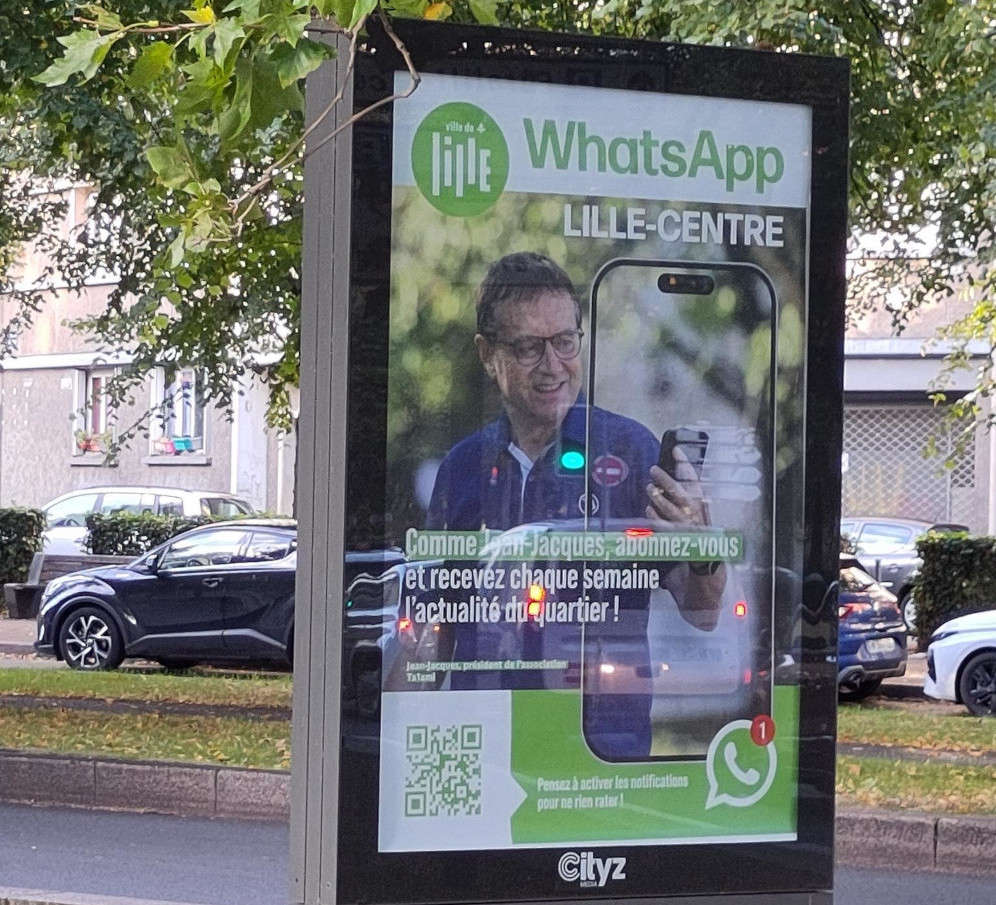
                <p dir="ltr">Apparently not the city of Lille. But if we widen the question, hardly anyone, really.</p>
<p dir="ltr">Most of the time, using WhatsApp is a non-choice. It's to keep up with your hiking club. Or the parents' group. Or a weekend with friends. It's hard to organize around an alternative in such small groups, because of <a href="https://en.wikipedia.org/wiki/Network_effect"  class="extlink extlink-icon-1"  >network effects</a>. So yes, I gave in and reinstalled WhatsApp recently, after fiercely boycotting it for several years. Some purist free software advocates and "alternuméristes" (people committed to digital alternatives) will swear that for them (in my experience, they are often men) it's a firm no, no WhatsApp, period... But when you dig a little, it turns out their wife (or a relative) is on WhatsApp and maintains the social ties. Or else everyone around them has to make an extra effort to reach them. Either way, let's be honest: that's not satisfactory. As is often the case, digital technology amplifies existing social realities. We know that in couples, it is generally the woman who takes care of maintaining social relationships, a phenomenon <a href="https://hal.science/hal-02881589/document"  class="extlink extlink-icon-1"  >documented in sociology</a> under the name of the domestic and social mental load. In short, doing without WhatsApp is fine, but we need to realize that at the individual level it often remains a privilege (of gender, class, economic and cultural standing).</p>
<p dir="ltr">What is particularly dismaying in the case of Lille's city hall is that this is an organization (here, a large local authority) with the means (strategic, financial, human, technical) and the critical mass to offer a credible alternative to a proprietary social network owned by an American company, Meta (you know, one of the most toxic companies on earth). In short, Lille's city hall had a choice between WhatsApp and an alternative, digital or not.</p>
<p dir="ltr"><a href="https://louisderrac.com/articles/migration-twitter-vers-bluesky-un-technosolutionnisme/"  class="extlink extlink-icon-1"  >In November 2024</a>, I wrote the following (translated from French):</p>
<blockquote dir="ltr">
<p dir="ltr">Let's be clear: the burden of all "digital eco-gestures" should not fall on individual users. This far-reaching reflection on the state of social networks, the design of alternatives, the mobilization required: all of it should be carried by intermediary bodies such as trade unions, political parties, but also the media, public interest organizations, associations, public agencies and European governments. Especially since this is not a new situation. All of X's problems existed before Musk's takeover, which only removed the last safeguards. Dominant social networks have been a democratic problem for a long time (as a reminder, Cambridge Analytica was in 2018), as the French National Digital Council recently pointed out again, <a href="https://cnnumerique.fr/lettre-dinformation/musk-nest-pas-notre-projet-en-voici-un-autre"  class="extlink extlink-icon-1"  >having made the courageous choice to leave X and call for the building of European alternatives</a>.</p>
</blockquote>
<p dir="ltr">Two years later, nothing has changed. So you may find me harsh, but I believe that choosing WhatsApp when you are a local authority the size of the city of Lille, in 2026 (a pre-election year), is a political and strategic blunder.</p>
<p class="msg msg--highlight " dir="ltr">If you are an organization and want to take the time to think through a digital strategy that is both ambitious AND <a href="https://louisderrac.com/numerique-acceptable/"  class="extlink extlink-icon-1"  >acceptable</a> (sustainable, chosen, emancipatory), that is what I offer through <a href="https://resnumerica.fr/"  class="extlink extlink-icon-1"  >Resnumerica</a>. Get in touch :)</p>
            ]]>
        </content>
    </entry>
    <entry>
        <title>Draining the digital bathwater (to start over with cleaner water) ?</title>
        <author>
            <name>Louis Derrac</name>
        </author>
        <link href="https://blog.louisderrac.com/en/draining-the-digital-bathwater/"/>
        <id>https://blog.louisderrac.com/en/draining-the-digital-bathwater/</id>
        <media:content url="https://blog.louisderrac.com/en/media/posts/545/ondrej-supitar-9GxwYyyfD-c-unsplash22.jpg" medium="image" />
            <category term="tech"/>

        <updated>2026-09-09T16:51:40+02:00</updated>
            <summary type="html">
                <![CDATA[
                        <img src="https://blog.louisderrac.com/en/media/posts/545/ondrej-supitar-9GxwYyyfD-c-unsplash22.jpg" alt="A photo of a dirth bathtub" />
                    Translation's note: this piece responds to the release of France's 2025 PISA results, the OECD's Programme for International Student Assessment, which measures 15-year-olds' performance across participating&hellip;
                ]]>
            </summary>
        <content type="html">
            <![CDATA[
                    <p><img src="https://blog.louisderrac.com/en/media/posts/545/ondrej-supitar-9GxwYyyfD-c-unsplash22.jpg" class="type:primaryImage" alt="A photo of a dirth bathtub" /></p>
                <p class="msg msg--info" dir="ltr">Translation's note: this piece responds to the release of France's 2025 PISA results, the OECD's Programme for International Student Assessment, which measures 15-year-olds' performance across participating countries every three years. The French Ministry of Education's statistics office (DEPP) published its national report on the 2025 results, which is the <a href="https://www.education.gouv.fr/depp/pisa-programme-international-pour-le-suivi-des-acquis-des-eleves-41558"  class="extlink extlink-icon-1"  >"rapport 2025"</a> referenced below.</p>
<p dir="ltr">It's the usual story: the latest PISA results are out and everyone's worked up about it. Let me say upfront, I haven't gone through the <a href="https://www.education.gouv.fr/depp/pisa-programme-international-pour-le-suivi-des-acquis-des-eleves-41558"  class="extlink extlink-icon-1"  >2025 report</a> in detail, so I'm not going to hand you an armchair analysis or throw out proposals as spectacular as they are dumb. But what I'm seeing on my timeline is a lot of people getting indignant about any link drawn between "screens," "social media," and declining academic performance.</p>
<p dir="ltr">Of course the situation is complex, multi-causal, and deserves nuance. Of course schools have been under strain for years. Reforms keep piling up with no coherent vision, exhausting teachers who are underpaid and undervalued. Human and financial resources are lacking. And the "digital revolution" has swallowed up far too much of the Ministry of National Education's intelligence and energy, crowding out reflection on pedagogy, the very form school takes, school buildings, and education's place in society.</p>
<p dir="ltr">But saying, or letting it be implied, that digital technology (meaning here the dominant social media platforms) has nothing to do with it is what I call technorassurisme: tech-reassurance-ism, the mirror image of "moral panic," an equally unexamined reflex that insists technology is always fine, actually. I've been writing about this since 2024: <a href="https://louisderrac.com/articles/eduquer-au-numerique-dans-la-ligne-de-crete-entre-paniques-morales-et-technorassurisme/"  class="extlink extlink-icon-1"  >Educating for the digital world on the ridge between "moral panics" and tech-reassurance-ism</a> (article in French).</p>
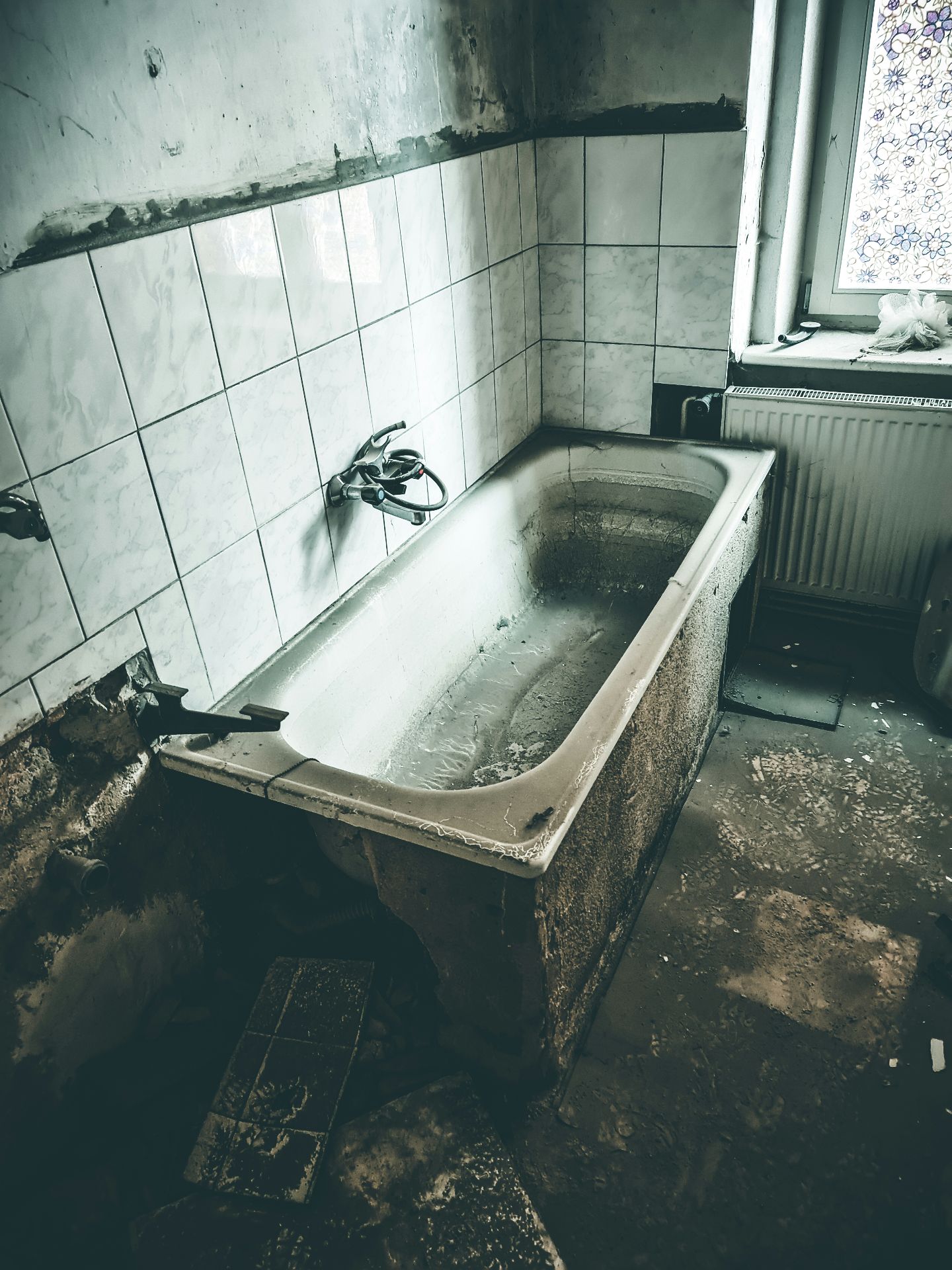
<p dir="ltr">I think we need to recognize, especially those of us who advocate for an "alternative," more ethical digital culture (what I call alternumérisme, roughly: digital-alternativism), that for most non-geeks, "digital" boils down to alienating, toxic platforms. That's not a value judgment, it's an observation. There was never a popular, emancipatory democratization of horizontal sharing and knowledge-based digital tools. What happened instead was the mass adoption of smartphones and a handful of social platforms, which have grown increasingly toxic through what Cory Doctorow calls enshittification. And the bill is coming due, not just for young people, but for society as a whole, for the quality of our democratic debate. Let's stop defending these platforms out of fear that we'll throw out "digital" along with the bathwater. If you want my opinion, I think the bathwater is filthy, and maybe it's time to consider dumping it and putting in clean water instead (a metaphor I came up with on the spot, take it for what it's worth).</p>
<p dir="ltr">In his book <em>Pris dans la toile. De l'utopie d'internet au capitalisme numérique</em> (Caught in the Web: From Internet Utopia to Digital Capitalism - in French only, no English edition at time of writing), Sébastien Broca examines the ties that have existed from the start between Big Tech and various organizations defending digital rights and civil liberties. He shows that the main digital "alternatives" developed in symbiosis with these companies and actually helped them grow, even as they appeared to be fighting them. In the same way, many social movements, free-software advocates, digital-rights activists, also got "caught in Big Tech's web," as these companies managed to co-opt much of the discourse and many of the practices that once threatened them. Which makes sense, since these worlds overlap and share a lot of the same worldview: libertarianism, or at least a libertarian-leaning, maximalist and meritocratic view of free speech; distrust of the state more than of private companies; and a sociology that skews WASP (White Anglo-Saxon Protestant) and upper-middle-class professionals. I strongly recommend reading this bracing book for anyone in our ecosystem.</p>
<p dir="ltr">Let's stop being Big Tech's useful idiots in defense of some fantasized version of "digital technologies", or "the Internet". Let's take stock of the actual balance of power, and let's adjust our strategies accordingly.</p>
            ]]>
        </content>
    </entry>
    <entry>
        <title>Surprise and shine</title>
        <author>
            <name>Louis Derrac</name>
        </author>
        <link href="https://blog.louisderrac.com/en/surprise-and-shine-2/"/>
        <id>https://blog.louisderrac.com/en/surprise-and-shine-2/</id>
        <media:content url="https://blog.louisderrac.com/en/media/posts/543/e575514c8efa3487.jpeg" medium="image" />
            <category term="tech"/>

        <updated>2026-09-09T15:54:13+02:00</updated>
            <summary type="html">
                <![CDATA[
                        <img src="https://blog.louisderrac.com/en/media/posts/543/e575514c8efa3487.jpeg" alt="Un orateur se tient debout sur une scène, micro en main, face à un public. La légende révèle son argumentaire : « Et si je vous disais qu’il existe un produit qui rendrait vos vies bien plus difficiles, mais qui me rendrait beaucoup plus riche ? »" />
                    What if I told you there was a product that would make all of your life much worse, but me a lot richer? That's roughly&hellip;
                ]]>
            </summary>
        <content type="html">
            <![CDATA[
                    <p><img src="https://blog.louisderrac.com/en/media/posts/543/e575514c8efa3487.jpeg" class="type:primaryImage" alt="Un orateur se tient debout sur une scène, micro en main, face à un public. La légende révèle son argumentaire : « Et si je vous disais qu’il existe un produit qui rendrait vos vies bien plus difficiles, mais qui me rendrait beaucoup plus riche ? »" /></p>
                <blockquote>
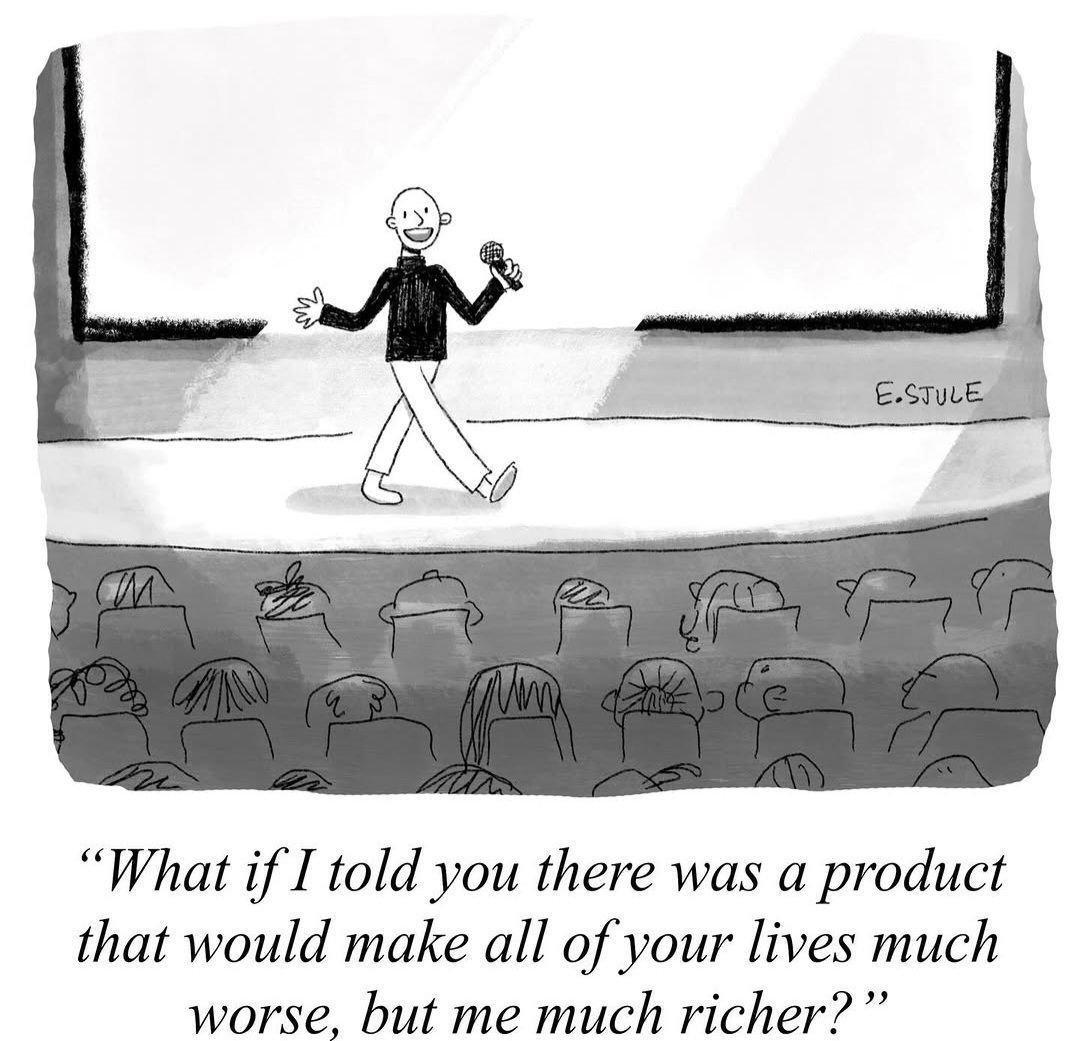
<p dir="ltr">What if I told you there was a product that would make all of your life much worse, but me a lot richer?</p>
</blockquote>
<p dir="ltr">That's roughly how I feel watching this summer's endless string of keynotes and Google I/O style events roll by, through one heatwave after another. The Google Pixel 11 is out. The iPhone 18 is coming. So what?</p>
<p dir="ltr">Is this the kind of technology that's going to shrink humanity's footprint on the living world? Cut our carbon impact? Stop the paving-over of land? Reduce the space given to the private car? No, not at all. What we're being offered is a few more megapixels on the camera, a bit more AI bolted on. Which means a more powerful chip, more RAM. The denial just keeps going. For how much longer?</p>
<p dir="ltr">Because here's the worst part: these devices don't even make us happier with each new release. If anything, it's getting worse. Honestly, I have zero interest left in following this kind of tech news, even though I was a techno-enthusiast from my teenage years, and an Apple fanboy from 2006 onward. Until recently I kept following it, out of curiosity, out of fascination. Now it just disgusts me.</p>
<p dir="ltr">On <a href="https://alternatives-numeriques.fr/"  class="extlink extlink-icon-1"  >Alternatives numériques</a>, the french <em>alternumériste</em> outlet I've decided to fully relaunch this year, I want to shine a light on "a different kind of digital." Not the kind that ships a new product every year to fill shareholders' pockets. A digital technology that's genuinely useful and emancipatory, one that seriously reckons with planetary limits, one that also rethinks the entrepreneurial and capitalist model (looking at you, cooperatives!). Plenty of articles are already waiting for you on the site.</p>
<p dir="ltr">Stay tuned for what's next. And in the meantime, don't cave and buy the new iPhone or the new Pixel. Be <em>alternuméristes</em>: get a <a href="https://murena.com/shop/smartphones/brand-new/fairphone-gen-6-plus/partner/louisderrac/?campaign=rentree2026&amp;ref=alternatives-numeriques.fr"  class="extlink extlink-icon-1"  >Fairphone running /e/OS</a>, or a <a href="https://ekimia.fr/produit/pixel8-gos/"  class="extlink extlink-icon-1"  >refurbished Pixel running GrapheneOS</a>. Even better, <a href="https://commown.coop/smartphones/"  class="extlink extlink-icon-1"  >rent one from Commown</a>!</p>
            ]]>
        </content>
    </entry>
    <entry>
        <title>&quot;Technical tools are neutral, take this knife for example&quot;</title>
        <author>
            <name>Louis Derrac</name>
        </author>
        <link href="https://blog.louisderrac.com/en/technical-tools-are-neutral/"/>
        <id>https://blog.louisderrac.com/en/technical-tools-are-neutral/</id>
        <media:content url="https://blog.louisderrac.com/en/media/posts/541/technical-neutrality-en.png" medium="image" />
            <category term="tech"/>

        <updated>2026-09-09T11:39:06+02:00</updated>
            <summary type="html">
                <![CDATA[
                        <img src="https://blog.louisderrac.com/en/media/posts/541/technical-neutrality-en.png" alt="Infographic titled &quot;The &#x27;neutrality&#x27; of technology&quot;. It compares two knives to illustrate that technology is not neutral. On the left, a round and harmless butter knife. On the right, a sharp and dangerous hunting knife." />
                    Technologies, as such, are neutral - that is, neither good nor bad: it all depends on how we use them. Can't a knife be used&hellip;
                ]]>
            </summary>
        <content type="html">
            <![CDATA[
                    <p><img src="https://blog.louisderrac.com/en/media/posts/541/technical-neutrality-en.png" class="type:primaryImage" alt="Infographic titled &quot;The &#x27;neutrality&#x27; of technology&quot;. It compares two knives to illustrate that technology is not neutral. On the left, a round and harmless butter knife. On the right, a sharp and dangerous hunting knife." /></p>
                <blockquote>
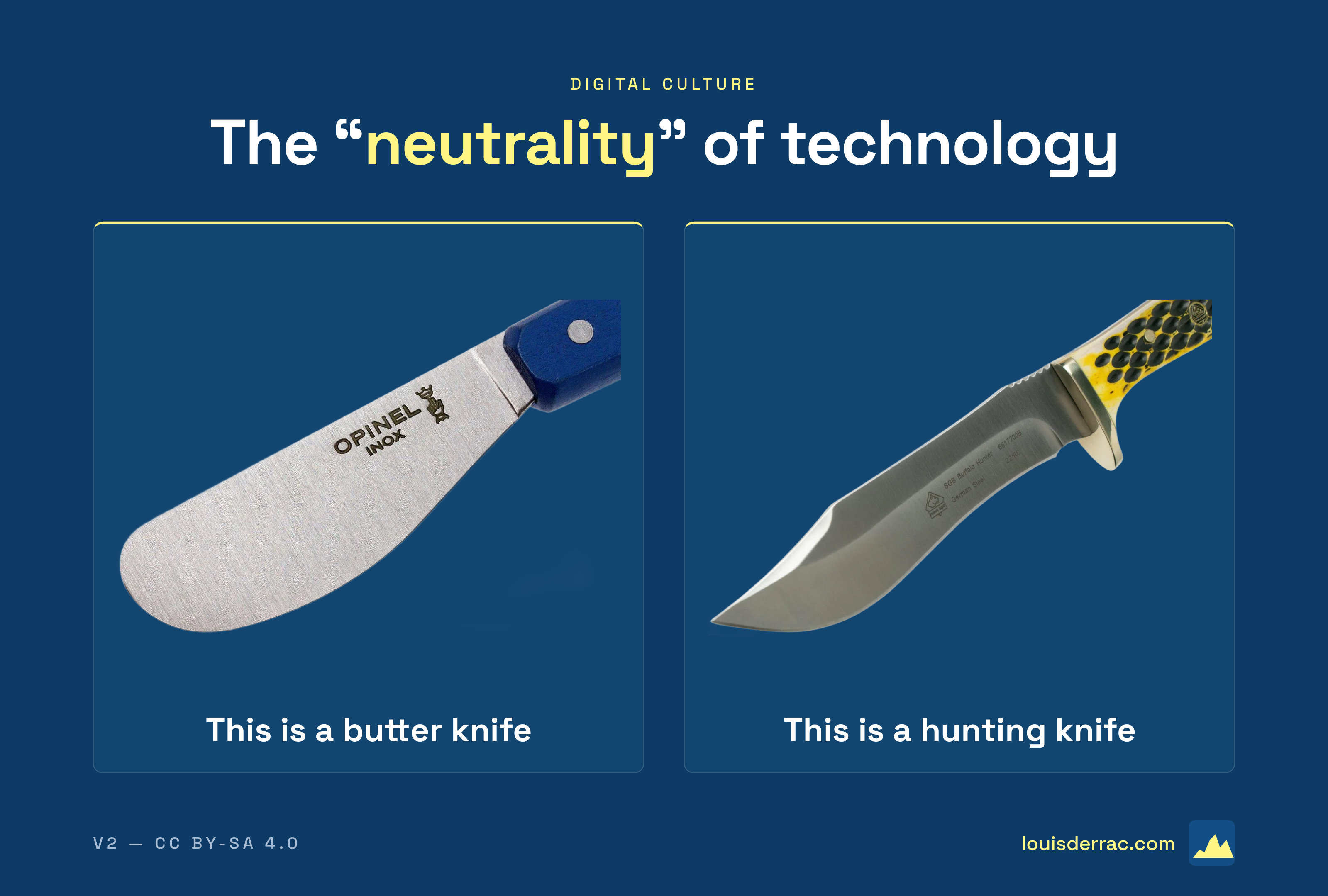
<p>Technologies, as such, are neutral - that is, neither good nor bad: it all depends on how we use them. Can't a knife be used just as well to butter a slice of bread as to kill a person?</p>
</blockquote>
<p>We hear or read this sentence almost systematically whenever the impact of technologies on our lives is discussed. The underlying assumption is that it makes no sense to criticize technologies, since they would be neutral and their effects would depend exclusively on our uses and practices. For example, Facebook or TikTok are neither good nor bad; it depends on what we do with them. The same goes for generative AI systems or video surveillance systems.</p>
<p>Much has been written on this subject, and it is sad that even today we still have to challenge this supposed "neutrality of technology" (which is omnipresent in debates about AI, for example). But allow me a little demonstration aimed at the general public, using the illustration below, which you are obviously free to reuse (download its editable version for Gimp).</p>
<p>Do you see where I'm going with this? Do you see the difference between these two knives? One was designed - with "design" in the true sense of the word - to kill, the other was not. One is pretty, colorful; the other is dark, even camouflaged. They are both knives, but conceived for two totally different practices and uses.</p>
<p>Knives, like any technical object (however simple or complex), are absolutely not neutral. They are designed with an intention, for a specific purpose, with systems of biases and beliefs. This design predisposes certain practices and uses (we then speak of affordance). Keep this in mind every time you read or hear that such an algorithm or such an AI is neutral...</p>
<h2>Going Further with Damasio</h2>
<p>To go further, I'd like to share an excerpt from Damasio's recent essay, <em><a href="https://fr.wikipedia.org/wiki/Vall%C3%A9e_du_Silicium"  class="extlink extlink-icon-1"  >Vallée du Silicium</a></em> (Silicon valley), which I find both clear and powerful:</p>
<blockquote>
<p>To these techno-critical approaches, Silicon Valley often opposes this cliché, which should be shot down without warning and at point-blank range. It goes like this: technology is neutral; its impact ultimately depends only on whether we make good or bad use of it.</p>
<p>This is a short idea, and even a stupid one - quadruply stupid. It is never useless to restate why:</p>
<p>1° Because technology carries within it a latent value: efficiency. In other words: the possibility of acting strongly on our environments. Every machine predisposes the user to make efficiency the value of their action, before any choice on their part. This value has contaminated all domains to the point that a startup founder today must be high-performing in professional, economic, athletic, and even sexual spheres.</p>
<p>More profoundly, technology is a way of revealing reality as that which must be harnessed, as Heidegger already pointed out - that is, brought to reason, mobilized, exploited, and compelled to deliver energy that can be extracted and accumulated. This, obviously, is anything but neutral. Other relationships to reality were and remain possible: the search for harmony, listening, contemplation, symbiosis...</p>
<p>2° Because upstream, technological innovation depends on Research, which itself depends on research funding or venture capital invested, and therefore already on a strong preselection of discoveries, products, and services deemed a priori "useful" to develop because they are profitable. The machine thus always remains "social before being technical" (Deleuze), meaning that within a capitalist universe, to be ultimately manufactured, it presupposes a market expectation and profitability. Millions of innovations that would improve our common condition will never cross the threshold of production. There is therefore no neutrality, even in the very possibility of existing.</p>
<p>Let's take two examples. An RFID chip predisposes, from its very conception, that we will seek to identify shoes, comfort objects, birds, lynxes, trees, motorcycles, and even our own children to ensure the traceability of these targets: nothing can exist or move anymore without being kindly tracked. "Give me your coordinates." Generative AI: its technological developments will always be subject to the biases and imperatives (financial, governmental, even personal) of those who control them and profit from them, and not aligned with a search for the common good or the enlightened education of all.</p>
<p>3° Because downstream, a technology induces a multitude of effects, often difficult to anticipate: it reinvents practices and reformats behaviors, it sometimes gives birth to an entire culture (massively multiplayer games, internet dances, animatics) simply through the new interactions it offers. Using it already means transforming one's relationship to oneself and one's relations with others, creating new grips and consenting to future controls by outsourcing old capacities to the app. The digital constantly delivers unexpected options that we never imagined would enter into usage. Mobile geolocation was not originally intended, nor was the explosion of autocompleted SMS or the generalization of a social norm: being reachable at all times. Generative AI was not designed to humiliate women with elaborate pornographic deepfakes created from ordinary videos. Your emails were not meant to be read and datamined.</p>
<p>4° Finally, because every technology carries within it a new relationship to the world. We think we are using a refrigerator when it is our way of feeding ourselves that is revolutionized by the storage of fresh food. The machine situates our freedom, and our freedom is exercised facing it, within it. We are free in our uses of the machine, even free not to use it, sometimes. But this is a situated freedom, a free will exercised within a world transformed and re-potentialized by the machine, where it becomes impossible to behave as if it did not exist. The car literally "invented" roads, parking lots, and sidewalks; it called for oil extraction and entirely re-founded land-use planning. Social networks invented community without presence, self-exposure, the selfie, possible exclusion, harassment, and digital stoning. AI is currently inventing self-conversation and the digital twin, among hundreds of reinventions of our ways of working.</p>
<p>By this fourfold measure, to still believe in the neutrality of the technologies offered to us is no longer even naivety. It is a political fault.</p>
</blockquote>
            ]]>
        </content>
    </entry>
    <entry>
        <title>Hello world</title>
        <author>
            <name>Louis Derrac</name>
        </author>
        <link href="https://blog.louisderrac.com/en/hello-world/"/>
        <id>https://blog.louisderrac.com/en/hello-world/</id>
        <media:content url="https://blog.louisderrac.com/en/media/posts/546/alexander-shatov-DHl49oyrn7Y-unsplash1.png" medium="image" />
            <category term="now"/>

        <updated>2026-09-08T18:37:00+02:00</updated>
            <summary type="html">
                <![CDATA[
                        <img src="https://blog.louisderrac.com/en/media/posts/546/alexander-shatov-DHl49oyrn7Y-unsplash1.png" alt="A picture of one of the first mac saying hello" />
                    As part of my journey—my deep dive, if you will—into the Indieweb, I’ve been reading more and more English-language blogs (while still reading just as&hellip;
                ]]>
            </summary>
        <content type="html">
            <![CDATA[
                    <p><img src="https://blog.louisderrac.com/en/media/posts/546/alexander-shatov-DHl49oyrn7Y-unsplash1.png" class="type:primaryImage" alt="A picture of one of the first mac saying hello" /></p>
                <p>As part of my journey—my deep dive, if you will—into the Indieweb, I’ve been reading more and more English-language blogs (while still reading just as many French-language ones). I want to join this international community and contribute to it myself.</p>
<p>So I’ll be translating some of my posts on this blog into English, and I’ll be writing some specifically for that audience. I sure hope to elevate my writing skills in the process!</p>
<p>Hello there English world.</p>
            ]]>
        </content>
    </entry>
    <entry>
        <title>Summer 2026 - Fires #2</title>
        <author>
            <name>Louis Derrac</name>
        </author>
        <link href="https://blog.louisderrac.com/en/summer-2026-fires-2/"/>
        <id>https://blog.louisderrac.com/en/summer-2026-fires-2/</id>
        <media:content url="https://blog.louisderrac.com/en/media/posts/524/plxthumbnailer.jpg" medium="image" />
            <category term="now"/>

        <updated>2026-08-19T15:22:59+02:00</updated>
            <summary type="html">
                <![CDATA[
                        <img src="https://blog.louisderrac.com/en/media/posts/524/plxthumbnailer.jpg" alt="Une bande dessinée en quatre cases :  Case 1. Poivre et Carotte, une jeune sorcière accompagnée de son chat, achète des légumes au marché, son balai dans le dos. La ville est à moitié en flammes, pourtant c&#x27;est jour de marché et la foule est dense. Le vendeur, un chèvre-nain, lui répond. Poivre : « Mais… n&#x27;y a-t-il pas un… » Vendeur : « …incendie ? Quel incendie ? Il fait juste un peu chaud aujourd&#x27;hui. »  Case 2. Une dame chic passe devant eux. Un chien-nain se vante. Dame : « Quelqu&#x27;un se plaint ? Je vais très bien, merci. Il suffit d&#x27;installer un puits chez soi, comme nous l&#x27;avons fait. » Chien-nain : « Il n&#x27;y a pas d&#x27;incendie, gamine ! C&#x27;est de la pure propagande elfique ! »  Case 3. Poivre pointe du doigt l&#x27;incendie en arrière-plan, sous le regard surpris de la dame et de l&#x27;homme. Poivre : « Mais… vous ne le voyez pas ? »  Case 4. La dame chic, le vendeur et le chien-nain hurlent tous ensemble contre Poivre. Elle s&#x27;envole sur son balai sans se retourner, faisant tourner son doigt près de sa tête (le geste pour dire « fou »). Ils sont désormais complètement engloutis par les flammes. Tous : « Tout va BIEN, d&#x27;accord ?!!! »" />
                    "Fire" by David Revoy − CC-BY-SA 4.0
                ]]>
            </summary>
        <content type="html">
            <![CDATA[
                    <p><img src="https://blog.louisderrac.com/en/media/posts/524/plxthumbnailer.jpg" class="type:primaryImage" alt="Une bande dessinée en quatre cases :  Case 1. Poivre et Carotte, une jeune sorcière accompagnée de son chat, achète des légumes au marché, son balai dans le dos. La ville est à moitié en flammes, pourtant c&#x27;est jour de marché et la foule est dense. Le vendeur, un chèvre-nain, lui répond. Poivre : « Mais… n&#x27;y a-t-il pas un… » Vendeur : « …incendie ? Quel incendie ? Il fait juste un peu chaud aujourd&#x27;hui. »  Case 2. Une dame chic passe devant eux. Un chien-nain se vante. Dame : « Quelqu&#x27;un se plaint ? Je vais très bien, merci. Il suffit d&#x27;installer un puits chez soi, comme nous l&#x27;avons fait. » Chien-nain : « Il n&#x27;y a pas d&#x27;incendie, gamine ! C&#x27;est de la pure propagande elfique ! »  Case 3. Poivre pointe du doigt l&#x27;incendie en arrière-plan, sous le regard surpris de la dame et de l&#x27;homme. Poivre : « Mais… vous ne le voyez pas ? »  Case 4. La dame chic, le vendeur et le chien-nain hurlent tous ensemble contre Poivre. Elle s&#x27;envole sur son balai sans se retourner, faisant tourner son doigt près de sa tête (le geste pour dire « fou »). Ils sont désormais complètement engloutis par les flammes. Tous : « Tout va BIEN, d&#x27;accord ?!!! »" /></p>
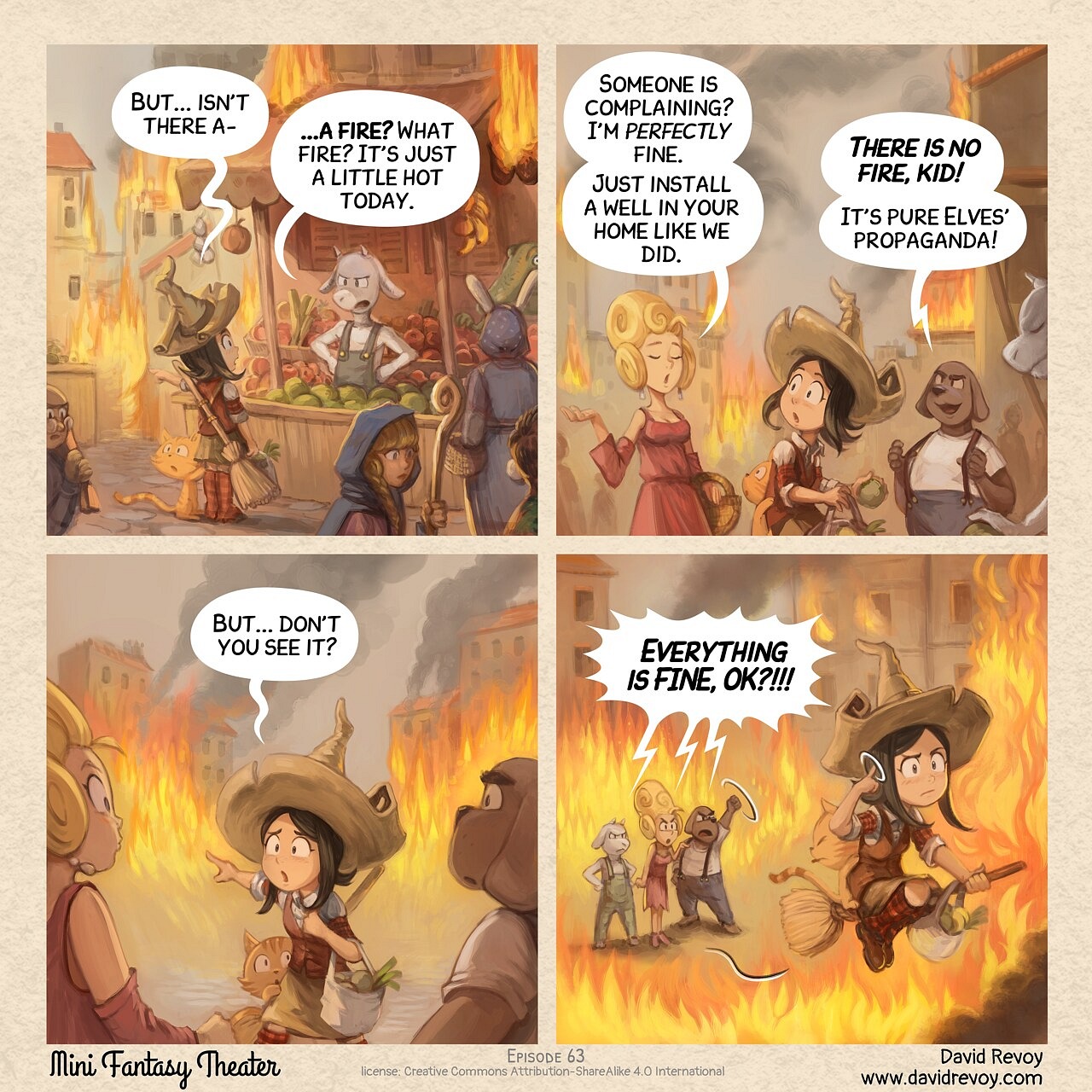
                <p>"<a href="https://www.davidrevoy.com/article1162/fire"  class="extlink extlink-icon-1" title="Fire" >Fire</a>" by David Revoy − <a href="http://creativecommons.org/licenses/by-sa/4.0/"  class="extlink extlink-icon-1"  >CC-BY-SA 4.0</a></p>
            ]]>
        </content>
    </entry>
    <entry>
        <title>Summer 2026 - Fires #1</title>
        <author>
            <name>Louis Derrac</name>
        </author>
        <link href="https://blog.louisderrac.com/en/ete-2026-feux-et-canicules-2/"/>
        <id>https://blog.louisderrac.com/en/ete-2026-feux-et-canicules-2/</id>
        <media:content url="https://blog.louisderrac.com/en/media/posts/523/17a12501b8c20611.png" medium="image" />
            <category term="now"/>

        <updated>2026-08-19T15:19:05+02:00</updated>
            <summary type="html">
                <![CDATA[
                        <img src="https://blog.louisderrac.com/en/media/posts/523/17a12501b8c20611.png" alt="Dessin humoristique montrant trois personnes en costume, debout dans un bureau moderne avec de grandes baies vitrées. À travers les vitres, on aperçoit une ville entière ravagée par un immense incendie, avec des flammes orange qui s&#x27;élèvent à l&#x27;horizon. Malgré le chaos visible, les personnages semblent détachés et l&#x27;un d&#x27;eux déclare : « Somehow we need to monetise this - and quickly » (« Il faut qu&#x27;on trouve un moyen de monétiser ça - et vite »). Le dessin est signé « Jonesy » en bas à gauche." />
                    Via Parents For Future sur Mastodon
                ]]>
            </summary>
        <content type="html">
            <![CDATA[
                    <p><img src="https://blog.louisderrac.com/en/media/posts/523/17a12501b8c20611.png" class="type:primaryImage" alt="Dessin humoristique montrant trois personnes en costume, debout dans un bureau moderne avec de grandes baies vitrées. À travers les vitres, on aperçoit une ville entière ravagée par un immense incendie, avec des flammes orange qui s&#x27;élèvent à l&#x27;horizon. Malgré le chaos visible, les personnages semblent détachés et l&#x27;un d&#x27;eux déclare : « Somehow we need to monetise this - and quickly » (« Il faut qu&#x27;on trouve un moyen de monétiser ça - et vite »). Le dessin est signé « Jonesy » en bas à gauche." /></p>
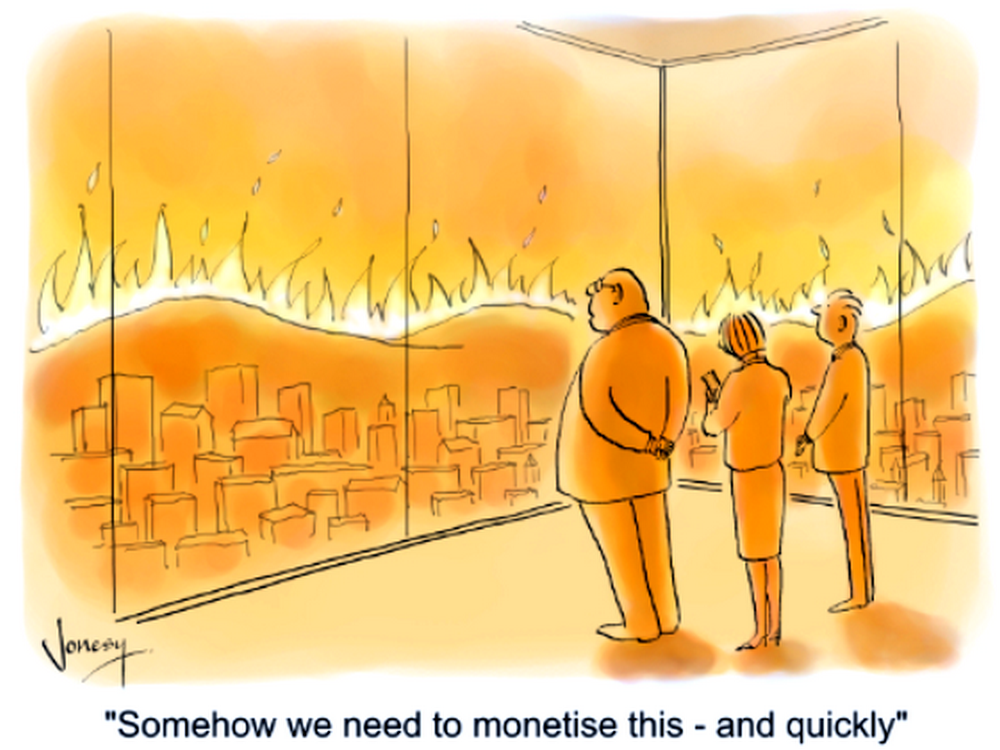
                <p>Via <a href="https://climatejustice.global/@parents4future/113797197811660385"  class="extlink extlink-icon-1"  >Parents For Future sur Mastodon</a></p>
            ]]>
        </content>
    </entry>
    <entry>
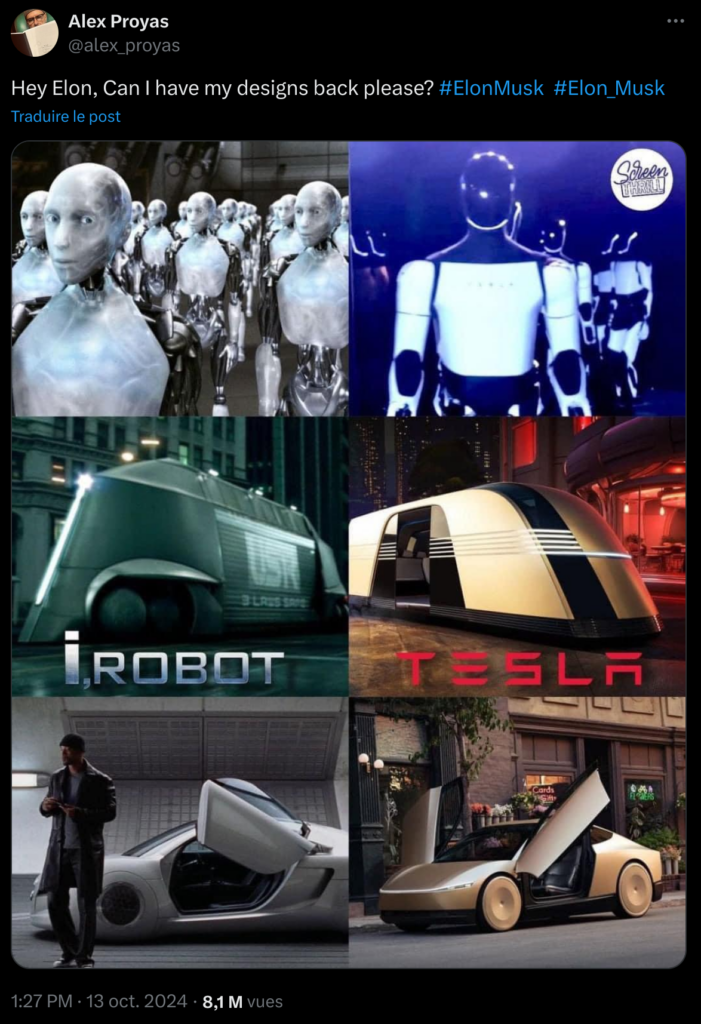
        <title>Hey Elon, can I have my designs back ?</title>
        <author>
            <name>Louis Derrac</name>
        </author>
        <link href="https://blog.louisderrac.com/en/hey-elon-can-i-have-my-designs-back/"/>
        <id>https://blog.louisderrac.com/en/hey-elon-can-i-have-my-designs-back/</id>
        <media:content url="https://blog.louisderrac.com/en/media/posts/349/Capture-decran-du-2024-11-02-16-21-12-701x1024-2.png" medium="image" />
            <category term="tech"/>

        <updated>2024-11-02T16:23:15+01:00</updated>
            <summary type="html">
                <![CDATA[
                        <img src="https://blog.louisderrac.com/en/media/posts/349/Capture-decran-du-2024-11-02-16-21-12-701x1024-2.png" alt="" />
                    I'm keeping this one warm for posterity. Pure genius, this Elon guy, pure genius.
                ]]>
            </summary>
        <content type="html">
            <![CDATA[
                    <p><img src="https://blog.louisderrac.com/en/media/posts/349/Capture-decran-du-2024-11-02-16-21-12-701x1024-2.png" class="type:primaryImage" alt="" /></p>
                <p><!-- wp:paragraph --></p>
<p> </p>
<p>I'm keeping this one warm for posterity. Pure genius, this Elon guy, pure genius.</p>
<p><!-- /wp:image --></p>
            ]]>
        </content>
    </entry>
    <entry>
        <title>Aaron Swartz: 8 Nov 1986 – 11 Jan 2013</title>
        <author>
            <name>Louis Derrac</name>
        </author>
        <link href="https://blog.louisderrac.com/en/aaron-swartz-8-nov-1986-11-jan-2013/"/>
        <id>https://blog.louisderrac.com/en/aaron-swartz-8-nov-1986-11-jan-2013/</id>
        <media:content url="https://blog.louisderrac.com/en/media/posts/231/aaron.png" medium="image" />
            <category term="tech"/>
            <category term="politics"/>

        <updated>2023-01-13T22:44:09+01:00</updated>
            <summary type="html">
                <![CDATA[
                        <img src="https://blog.louisderrac.com/en/media/posts/231/aaron.png" alt="" />
                    A bit late, but I'll pay my own tribute to Aaron Swartz, "the internet's own boy." From the deeply moving documentary drawn from his far&hellip;
                ]]>
            </summary>
        <content type="html">
            <![CDATA[
                    <p><img src="https://blog.louisderrac.com/en/media/posts/231/aaron.png" class="type:primaryImage" alt="" /></p>
                <p dir="ltr">A bit late, but I'll pay my own tribute to Aaron Swartz, "the internet's own boy." From the deeply moving documentary drawn from his far too short life, shared freely online, two moments stayed with me in particular.</p>
<p dir="ltr">At 21:00, Aaron compares the limitations of "old broadcast systems," radio and television, which offer only hundreds, or thousands, of channels, with the internet, where everyone can have their own channel: a blog, a Myspace page. Visionary, he's already pointing, in 2007, to the risk of gatekeepers becoming centralised: who controls access to content? Who decides who sees what, and who meets whom? Everyone can speak, but who gets heard?</p>
<p dir="ltr">At 1:23:00, in one of Aaron Swartz's last interviews, a journalist asks him how he sees the fight for the web continuing. He answers right back, not without a touch of mischief, "It's up to you!" Before going on to describe a vision of the internet and the web as a kind of pharmakon. Heads, the possibility of sharing knowledge, of speaking freely. Tails, surveillance technologies, centralisation, repression, control over information. For Aaron, these two sides can only coexist, but it's up to us to tip the balance one way or the other.</p>
<p dir="ltr">It's up to us to carry this fight forward, one that is above all not just a technological fight, but truly an economic, political and philosophical one. RIP Aaron, and thank you.</p>
<p dir="ltr"> </p>
<center><div class="post__iframe"><iframe loading="lazy" width="560" height="315" title="The internet's own boy : the story of Aaron Swartz" src="https://videos.domainepublic.net/videos/embed/dcafd5ca-acc2-456d-80e1-35626d3f40b0" allowfullscreen="allowfullscreen" sandbox="allow-same-origin allow-scripts allow-popups" frameborder="0"></iframe></div></center>
            ]]>
        </content>
    </entry>
</feed>